
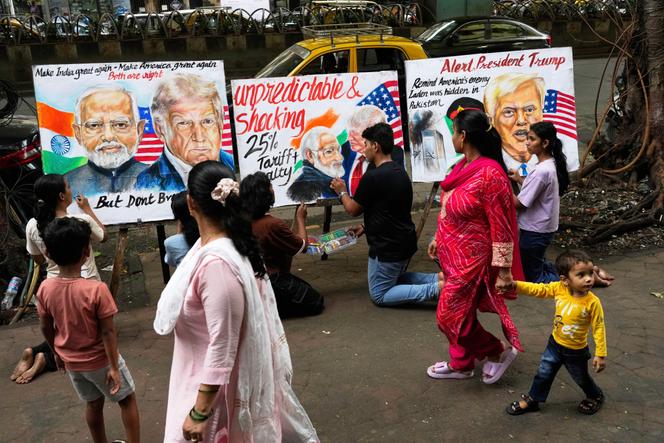
In a world reshaped by escalating trade tensions, the newly signed India-EU Pact stands as a testament to strategic recalibration in the face of mounting trade pressures largely attributed to former U.S. President Trump‘s protectionist policies. While never explicitly naming him during their announcement, both European Commission President Ursula von der Leyen and Indian Prime Minister Narendra Modi revealed an alliance forged out of necessity—an economic partnership designed to reduce dependence on unpredictable actors and stabilize the volatile terrain of international trade.
This accord, hailed as the « agreement of all agreements, » signals a bold departure from isolationist trends by slashing tariffs that once stifled bilateral commerce—cutting taxes on European vehicles entering India from a staggering 110% to merely 10%, and on wines from 150% to 20%. Such reductions sharply contrast with the United States’ retrenchment into protectionism, which erected new barriers with even long-standing partners like the EU. More than a mere trade deal, this pact refashions trade relations into a resilient framework capable of withstanding capricious trade policies while reinforcing geopolitical heft.
The Strategic Drivers Behind the India-EU Trade Agreement in Countering U.S. Tariff Policies
This landmark partnership emerges as an astute economic maneuver aimed at hedging risks posed by the unpredictable American trade agenda under Trump. While the pact itself was years in the making, Trump’s aggressive use of tariffs acted as a catalyst, accelerating negotiations that once languished. Economists note that this accord not only lessens the financial barriers that have hampered commerce but acts as a geopolitical signal: Europe and India are asserting their roles in a multipolar trading architecture where geopolitics intertwines deeply with economic strategy.
As the U.S. moves toward more isolationist tendencies, the European Union simultaneously seeks to diversify its portfolio of trade partners, engaging more deeply with emerging economies in Asia. Although talks with countries like Indonesia and Malaysia are ongoing, the India-EU pact currently sets the gold standard for forging pragmatic alliances. Parallel to this, Europe has eyed increasing cooperation with the Trans-Pacific Partnership members, notably Vietnam, the rotating chair in 2026, signaling a broader push beyond the Atlantic.
Economic Partnership Beyond Tariffs: The Implications for Global Trade Dynamics
The reduction of tariffs within this agreement transcends mere numbers, indicating a fundamental shift in the global trade policy landscape. With cars and luxury wines now more accessible across borders, economic actors from both zones gain renewed competitive edges while consumers enjoy wider choices at better prices. Observers argue that such openness not only benefits industries directly but signals a broader integration—one that could redefine supply chains and encourage bilateral investment.
Yet, complexity remains. The partnership navigates sensitive areas such as India’s ongoing negotiations with China and the shadowy politics surrounding Russian energy purchases. The EU and its partners wrestle with balancing commercial pragmatism against political values, a dilemma highlighted by NATO allies’ differing stances on sanctions and global security concerns. This balancing act marks the strategic alliance as a nuanced response to contemporary global challenges, underscoring the need to diversify to mitigate risks.
Geopolitical Underpinnings: How the India-EU Pact Shapes Bilateral Trade and Global Alliances
The India-EU pact does not exist in economic isolation. It reflects a broader geopolitical trend whereby bilateral trade agreements serve as instruments for countries to assert influence and counterbalance dominant powers. European leaders, conscious of growing US-China rivalry, seem to have recalibrated their approach, choosing engagement and diversification over reliance on unpredictable economic superpowers.
This maneuver also aligns with global calls from influential policymakers for middle powers to unite against the fragmentation of the international order. Through this lens, the pact serves both as an economic shield and a platform for enhanced dialogue and cooperation across key sectors including pharmaceuticals, finance, and technology. The high-profile involvement of titans such as HSBC and AstraZeneca underscores the deal’s reach beyond mere tariff adjustments to strategic industry collaboration.
