
In the ever-evolving world of financial markets, selecting the right trading platform is crucial for success. MetaTrader 4 (MT4) and MetaTrader 5 (MT5), both developed by MetaQuotes, dominate this space, widely adopted by brokers such as Pepperstone, IG Markets, Forex.com, XM, Oanda, ThinkMarkets, AvaTrade, and IC Markets. Traders often face the challenging decision of choosing between MT4’s straightforward, reliable forex-centric capabilities and MT5’s advanced, multi-asset features. As markets grow increasingly complex in 2025, this platform choice shapes trading experiences and potential outcomes significantly.
MT4 has maintained a loyal base due to its ease of use and stability, appealing especially to beginners and retail forex traders valuing simplicity. Conversely, MT5 caters to sophisticated investors seeking multi-asset access including stocks, commodities, and futures, paired with faster order execution and deeper analytical tools. Both platforms enable automation through Expert Advisors but differ in programming languages and backtesting capabilities, impacting strategic development.
Understanding the nuances between these two platforms goes beyond their interface; it influences strategy complexity, market access, and operational efficiency. The right choice depends on the trader’s style, asset preferences, and technological readiness. This exploration into MT4 and MT5 disparities unearths key features, performance metrics, and broker compatibility, providing clarity for traders preparing to navigate the market’s dynamic landscape.
Quick Overview:
- MT4 excels in simplicity and stability, ideal for forex-focused beginners.
- MT5 offers a broader asset range, including stocks and futures, with advanced analytical capabilities for experienced traders.
- MT4 supports basic algorithmic trading; MT5 introduces sophisticated multi-threaded backtesting and object-oriented programming for Expert Advisors (EAs).
- User interface on MT5 is more modern and feature-rich but demands higher system resources than MT4.
- Broker preferences vary, with most supporting MT4, though MT5 adoption grows owing to its versatility.
Key Feature Contrasts Between MetaTrader 4 and MetaTrader 5 in 2025
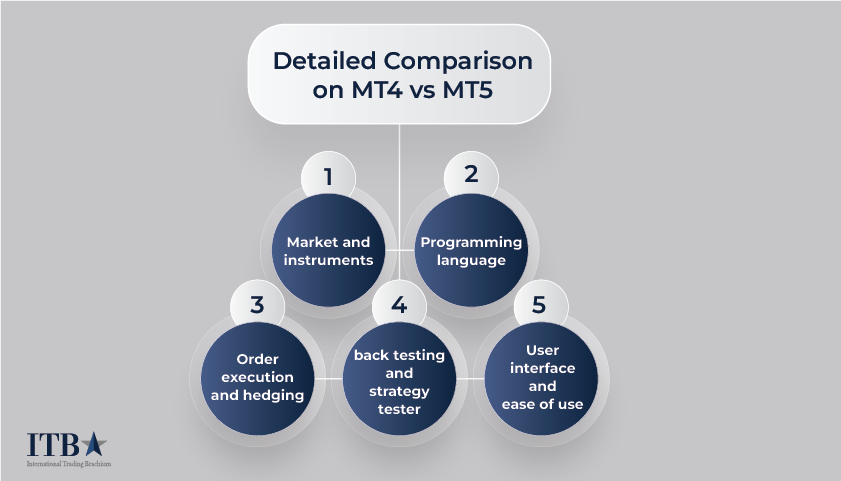
MetaQuotes’ MT4, launched in 2005, was revolutionary in its focus on forex and CFD markets, drawing users seeking a reliable, user-friendly platform. With 30 built-in technical indicators, 31 drawing tools, and 9 timeframe options, MT4 remains optimized for traders valuing straightforward charting and execution. Its execution modes, predominantly fill-or-kill, cater effectively to forex trade dynamics, and automation is facilitated through the MQL4 language, supporting a wealth of Expert Advisors and scripts, albeit with single-currency backtesting limitations.
MT5, introduced in 2010, expands beyond forex, embracing stocks, commodities, futures, and bonds. With 38 technical indicators and 44 graphical tools, it additionally offers 21 distinct timeframes, satisfying traders needing granular analytical depth. The platform supports varied order execution modes, including immediate or cancel (IOC) and return strategies, enhancing flexibility. Notably, MT5 features a fully integrated economic calendar and Depth of Market (DOM) visualization, vital tools for sophisticated market analysis. Its backtesting engine supports multi-currency and faster multi-threaded functionality using MQL5, lending itself to more complex, object-oriented operating expert advisors. These elements position MT5 as a powerhouse platform tailored to advanced trading demands.
Practical Implications for Traders
For newcomers navigating forex markets, MT4 offers a stable, lightweight experience, compatible even with lower-end devices and slower internet connections, which ensures uninterrupted trading. Its established ecosystem with brokerages like XM and Oanda guarantees liquidity and execution reliability, helping beginners build foundational skills without distraction.
By contrast, seasoned traders targeting diversified portfolios benefit from MT5’s comprehensive tools. Access to multi-asset trading across Pepperstone, IG Markets, and ThinkMarkets reduces fragmentation in management, while the enhanced order types facilitate sophisticated strategies. MT5’s advanced automation features open pathways for refined algorithmic trading, elevating strategic possibilities beyond MT4’s simpler capabilities.
Expert Advisor Compatibility and Automation: MT4 vs MT5
Automation remains a focal point for many traders leveraging MetaTrader’s platforms. MT4’s MQL4 scripting language supports reliable Expert Advisors that have empowered countless forex traders over years. However, limitations exist in backtesting multi-currency strategies, which can constrain diverse hedge or spread trading systems.
MT5, with its MQL5 language, advances automation by enabling object-oriented programming. This fosters development of complex EAs capable of analyzing multiple assets simultaneously and executing nuanced order types, crucial for professional-grade trading systems. Faster multi-threaded strategy testing expedites refinement processes, especially meaningful for traders adapting to fast-paced markets.
Nevertheless, MT5’s incompatibility with MT4 scripts and indicators forces users to rewrite or upgrade their existing automated tools, which can be a deterrent for those deeply embedded in the MT4 ecosystem.
Selecting the Ideal Platform for Forex Trading in 2025
Decision-making in platform selection is increasingly influenced by trading style and asset focus. Forex-dedicated traders, especially novices, find MT4’s simplicity and broad broker support from companies like AvaTrade and IC Markets attractive. Its lightweight design ensures consistent performance where infrastructure may be limiting. By sticking to core forex CFDs and automated strategies available on MT4, traders leverage a tried-and-true method aligned with their needs.
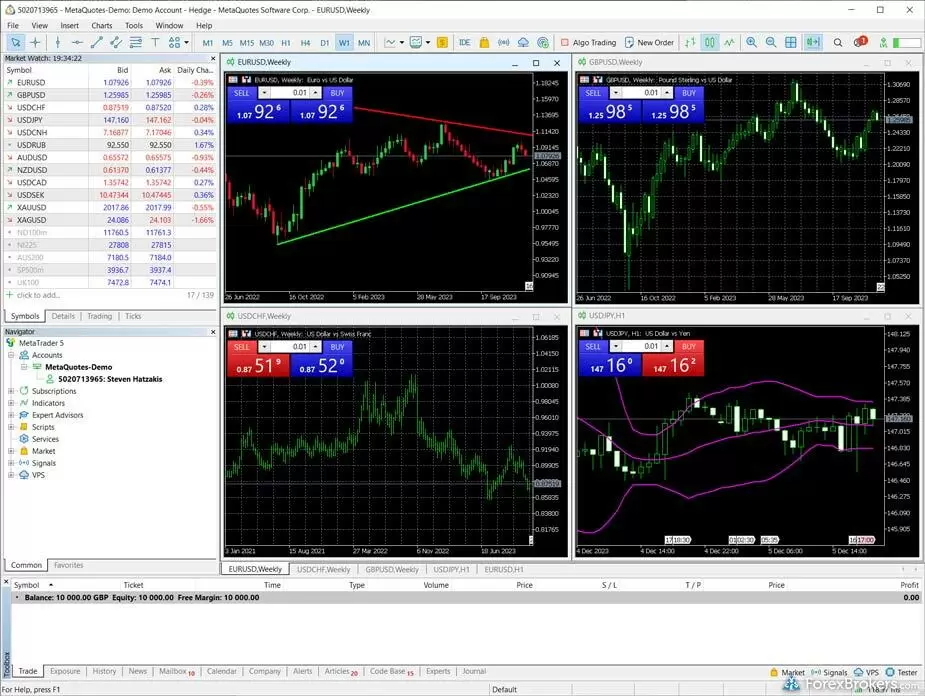
Traders seeking to expand into stocks, commodities, or futures, or those requiring deeper analytics and faster execution gravitate naturally toward MT5. The platform’s holistic market view, coupled with integrated economic data and enhanced order functionalities, serve professional and multi-asset investors best. However, newer users must prepare for a steeper learning curve and higher hardware demands.
Ultimately, the trading community’s gradual shift towards MT5 reflects a broader market evolution toward multi-asset versatility and analytical sophistication—a move brokers and traders alike are adapting to in 2025. Yet, MT4’s enduring presence underscores its unmatched simplicity and reliability as a Forex-focused powerhouse.
